
By Elliot Dziedzic
July 2, 2026
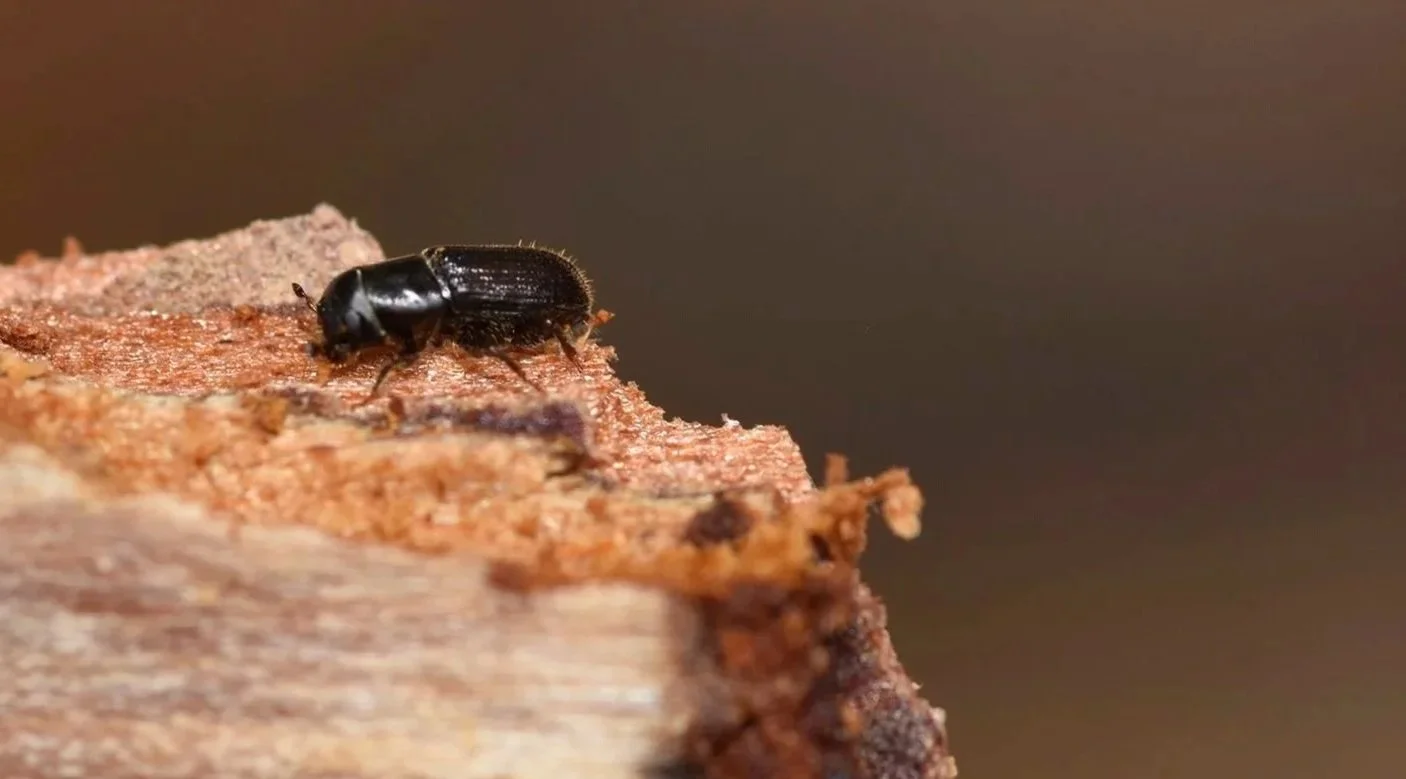
Along with Beech Leaf Disease, another threat is emerging in Provincetown's forests: the Southern Pine Beetle (Dendroctonus frontalis). First detected in the Pine Barrens of Long Island, New York, in 2014, Southern Pine Beetles have steadily expanded their range northward over the past 12 years, reaching Massachusetts and Cape Cod. Native to the southeastern United States and Central America, with a range extending from Nicaragua to the Carolinas, these beetles have benefited from warmer winters that have enabled them to survive farther north.
Southern Pine Beetles (SPB) aggressively attack a variety of pine species, often in groups numbering 1,000 or more. The beetles are tiny—only 2 to 4 millimeters long—and burrow through a tree's sap defenses to establish colonies beneath the bark. Both adult beetles and their larvae feed on the tree's phloem, disrupting the flow of nutrients and ultimately weakening or killing the tree. SPB infestations have become a growing concern in New England because they can spread rapidly and are extremely difficult to control. A single infestation can kill dozens of trees and continue expanding outward from the initial outbreak. Beetles spread primarily by flight and can also be carried by wind. When a beetle successfully attacks a tree, it releases pheromones that attract additional beetles, allowing infestations to grow quickly in size and intensity.
One of the first signs of an SPB infestation is the appearance of "pitch tubes"—small masses of pine sap that form on the bark of affected trees. These pitch tubes are part of the tree's natural defense system and are often described as resembling pieces of popcorn. As an infestation progresses, the tree's needles begin to discolor, changing from green to yellow and eventually orange before falling off. Additional evidence of SPB activity can be found beneath the bark, where characteristic S-shaped galleries created by beetle colonies become visible. While healthy trees can sometimes survive attacks, infestations are often fatal.
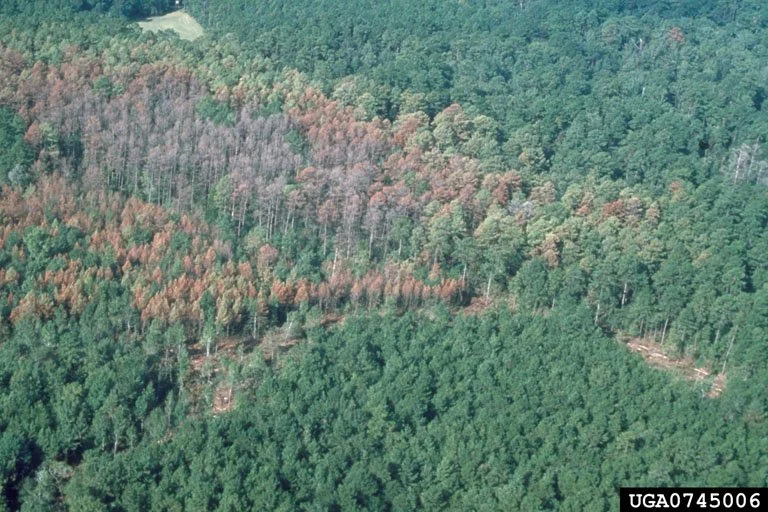
An outbreak among pines. The same could happen to Cape Cod’s Pitch Pines.
Photo: Center for Invasive Species and Ecosystem Health, University of Georgia.
On Cape Cod, the primary species affected are native Pitch Pines and White Pines. The Pitch Pine barrens of the Outer Cape may become increasingly vulnerable to SPB infestations in the coming years. Southern Pine Beetles experience high mortality at extremely cold temperatures, with approximately 90 percent mortality occurring at -7°F. However, such cold winter temperatures are becoming less consistent than they were historically.
Another challenge facing native pine forests is the increasingly dense condition of their ecosystems. Overgrown understories and closed canopies create ideal conditions for SPB outbreaks. Beetles are more successful in forests where Pitch Pines are crowded together and lack the open canopy structure necessary for healthy growth. In these environments, beetles can spread more easily from tree to tree, while the pines themselves experience greater stress due to competition for sunlight, water, and nutrients.
Healthy Pitch Pine forests typically have a basal area of less than 80 square feet per acre. Forests exceeding 100 square feet per acre are significantly more susceptible to SPB infestations because of their higher tree density. Historically, these ecosystems were maintained by periodic low-intensity fires that reduced brush, opened the canopy, and promoted healthier forest conditions. Without these natural processes, many New England pine forests have become increasingly vulnerable to insect outbreaks and other ecological stresses.
Current management efforts focus on monitoring the spread of Southern Pine Beetles and reducing forest density through prescribed burns and mechanical thinning. These practices help restore healthier forest conditions and slow the spread of infestations. In areas where pine beetles have caused significant tree mortality, restoration efforts are aimed at regenerating Pitch Pine forests with more open canopies, reduced understory growth, and greater ecological resilience. By restoring these natural conditions, land managers can help create forests that are healthier, more diverse, and better able to withstand future threats.
For more information check out the Massachusetts Southern Pine Beetle Response Plan
RESOURCES:
Information for this article was obtained from the Southern Pine Beetle Information Meeting offered by the North Atlantic Fire Science Exchange.